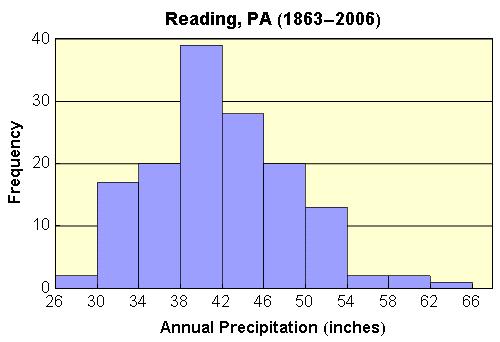
An important class of distributions or density curves in statistics is the normal distribution.
All normal distributions have the same overall shape that is often referred to as "bell shaped".
These shapes are symmetric about the center, which is the location of the mean, median and mode of the data set.
It appears that the precipitation frequency distribution for Reading is "almost normal" since it
is almost symmetric about the center and has a bell-shaped appearance. If students were to display precipitation
distributions for other cities, many of these would also have the same bell-shaped curve. Why is this
so? The answer lies in the fact that precipitation amounts, like many other natural phenomena, are the result
of many random factors. When this is the case, we expect a normal distribution.
Mentioned above was the fact that the center of a normal distribution is the mean.
The mean annual precipitation for the years 1863 to 2006 was 42.1 inches, which looks about right on the
histogram. It's quite obvious that the center (mean) for the Reading distribution would be quite different
than the center for a much drier city such as Salt Lake or Phoenix. Also, a city whose precipitation
from year to year is more consistent or more varied would have a histogram that is narrower or wider, respectfully.
So even though normal distributions have the same overall shape, they may have different centers (means) and have
different widths (deviations from the mean). The width of a normal distribution is quantified by computing
the standard deviation. For the Reading data, the standard deviation is 6.9 inches. (The formula to compute
this number is not given here, but can be found in any basic statistics text. Also, most calculators, spreadsheets
and statistics packages will compute the standard deviation.)
If we denote the mean by m and the standard deviation by s, then any normal distribution can be described by the 68-95-99.7 rule. This rule states
that: 68% of the data will lie within 1s of the mean m, 95%
of the data will lie within 2s of the mean m, and 99.7% of
the data will lie within 3s of the mean m . We can use the
68-95-99.7 rule as a means to check "how normal" the precipitation data are for Reading. This is
a good student exercise. We can also use properties of the normal distribution to answer a question such
as, "How likely is it that the precipitation for Reading will be between 30 and 31 inches in any given year?".
Details are left for statistics courses.
We obtained these and other precipitation data from the United States Historical Climate Network (USHCN), part of NOAA's National Climate Data Center.
For more recent precipitation and temperature values, go to DataSet#050.
Data source: United States Historical Climate Network (USHCN)
http://www.ncdc.noaa.gov/ol/climate/research/ushcn/ushcn.html








 Data Home | Math
Topics | Environment
Topics | Topics Matrix | Master List
| Help
Data Home | Math
Topics | Environment
Topics | Topics Matrix | Master List
| Help